The Living Sculpture: How to Style a Patio with Outdoor Planters
The Living Sculpture
The best outdoor spaces feel alive. Beautiful furniture creates the framework. Plants and the planters that hold them are what fill it with life.
A good outdoor planter isn't a small terracotta pot from the hardware store. It's a substantial, sculptural piece in its own right, sized to the space and built to weather beside your seating. Choose them well and the plants inside do most of the work.
At Frontera, we've spent over three decades curating the that turn backyards into destinations, alongside the that complete them. What follows is a guide to using planters as architecture — the finishing pieces that give an outdoor space its shape, rhythm and sense of place.

The Planter as Architecture
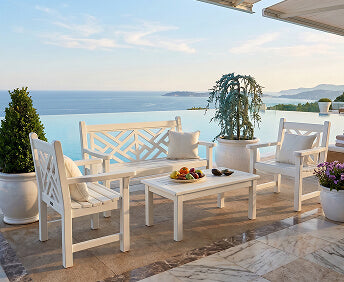
Planters deserve as much attention as the seating around them. In the best-designed outdoor spaces, they function as architecture. A tall pair of matched planters at the entrance to the patio marks the entry the way a doorway does. A row of substantial rectangular planters along the pool deck creates a green wall between the water and the dining area. A single oversized planter with a mature tree serves as the visual anchor around which the seating arranges itself.
Planters give a patio its bones. Even a beautifully furnished patio needs plants to feel complete.
Scale: The Single Most Important Decision
The most common error in planter design is undersizing. A twelve-inch clay pot with a small plant on a large deck reads as forgotten, no matter what is growing in it. The rule outdoor designers use — one worth memorizing — is that planters should be roughly one-third the height of the space they are anchoring, or one-half the depth of the piece of furniture they sit beside.
For a dining set on an eight-foot patio, a pair of planters twenty-four to thirty inches tall reads correctly. For a poolside cabana, a planter three to four feet tall carries the weight of the architecture behind it. For a small balcony, a single substantial planter — even eighteen inches — will outperform three small ones scattered around the edges.
Bigger is almost always better outside. The scale of a garden absorbs pieces that would overwhelm indoors, and outdoor planters should be sized accordingly.
Material: How to Choose a Planter That Lasts
An outdoor planter faces conditions no indoor pot ever does — freeze-thaw cycles, hard sun, heavy rain, and the weight of both wet soil and a growing plant. The materials that hold up over time are limited.
Fiberglass planters have become the resort-designer default for a reason. Light enough to move seasonally, indestructible under freeze-thaw, available in almost every color and finish, and increasingly indistinguishable from ceramic or stone at first glance. The best fiberglass planters look like museum pieces and will outlast their owners.
Cast concrete planters offer weight, substance, and a raw architectural quality that suits modern homes beautifully. They are functionally permanent — once placed, they are not moving — and they age gracefully with weather and time.
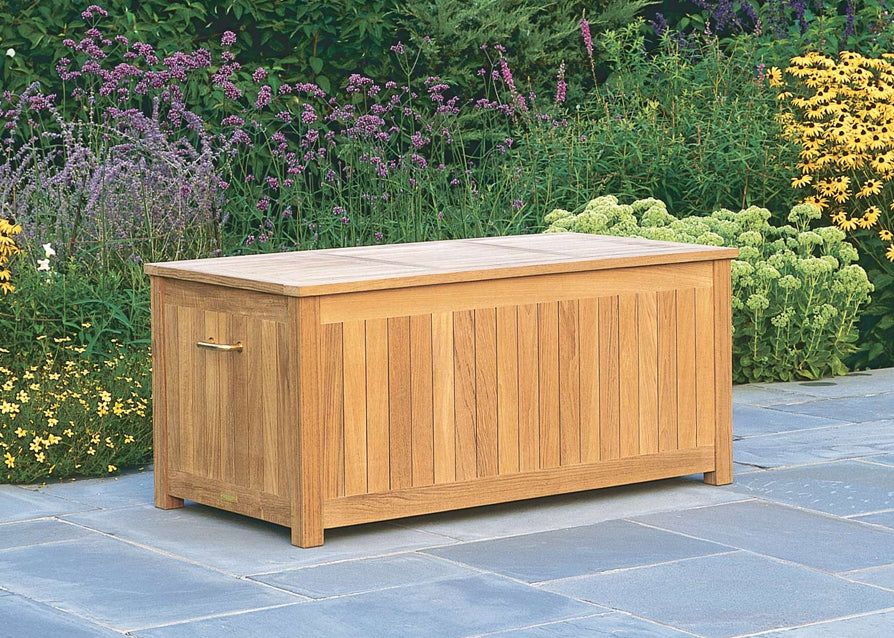
Teak or ipe wood planters bring warmth to an outdoor room and pair beautifully with matching outdoor furniture. They require occasional oiling to hold their color, or they weather to a quiet silver if left natural.
Traditional glazed ceramic is beautiful but fragile in cold climates — the freeze-thaw cycle cracks it. Reserve ceramic for warm-weather homes or for spots you can bring indoors in winter.
The Self-Watering Question
The single biggest change in outdoor planters over the past decade is the arrival of well-designed self-watering planters. The engineering is elegant: a reservoir at the base of the planter holds several days of water, and a wicking system draws the water up through the soil as the plant needs it. You fill the reservoir once every three or four days in summer, once a week in cooler weather, and the plant does the rest.
For anyone traveling in the summer, for busy households, or for anyone who has ever come back from a weekend away to find a beloved plant withered, self-watering planters are a small revolution. They also encourage healthier plants — plants that are consistently watered rather than alternately drenched and starved.
They do not replace all conventional planters. Deep-rooted trees, certain succulents, and container gardens with unusual soil needs still do better in conventional pots. But for the majority of patio planters — flowering annuals, herbs, small shrubs, ornamental grasses — self-watering has become the resort standard.

The Trellis: Vertical Gardens
Where planters give a patio its walls, give it its architecture. A well-placed trellis with a climbing vine — jasmine, clematis, climbing rose, honeysuckle — creates a green screen that grows more beautiful every year.
Trellises solve specific outdoor design problems that furniture cannot. They screen a neighbor's yard without a fence. They mark the edge of an outdoor room without a wall. They soften a bare stretch of siding or a blank fence. And they bring vertical layers to a garden that would otherwise stay horizontal.
Position matters. A trellis against a south-facing wall gives the plant the sun it needs; a trellis in a shaded corner will underperform. Give the trellis structural support if the vine is heavy — some mature climbers weigh more than you would expect — and plan for the plant to reach full coverage over two to three seasons rather than one.

The Seating Around the Planters
The relationship between planters and outdoor furniture is where an outdoor room comes together. A few principles that hold across most patios.
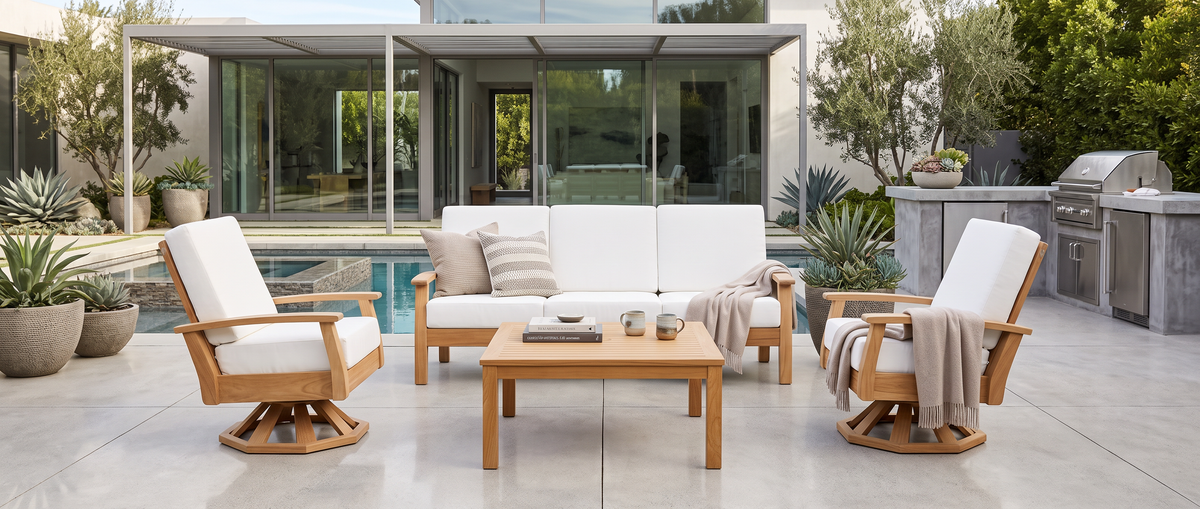
Place a substantial planter next to every seating cluster. A reads more sculpted when a pair of matched planters frames the table. A reads more designed when a tall planter with a small tree anchors one end.
Position planters at eye level from where people sit. The visual pleasure of a planter is largely lost if it sits below the sightline of the seated guest. A three-foot planter is often the right height for a dining chair; a taller planter belongs behind a lounge chair.
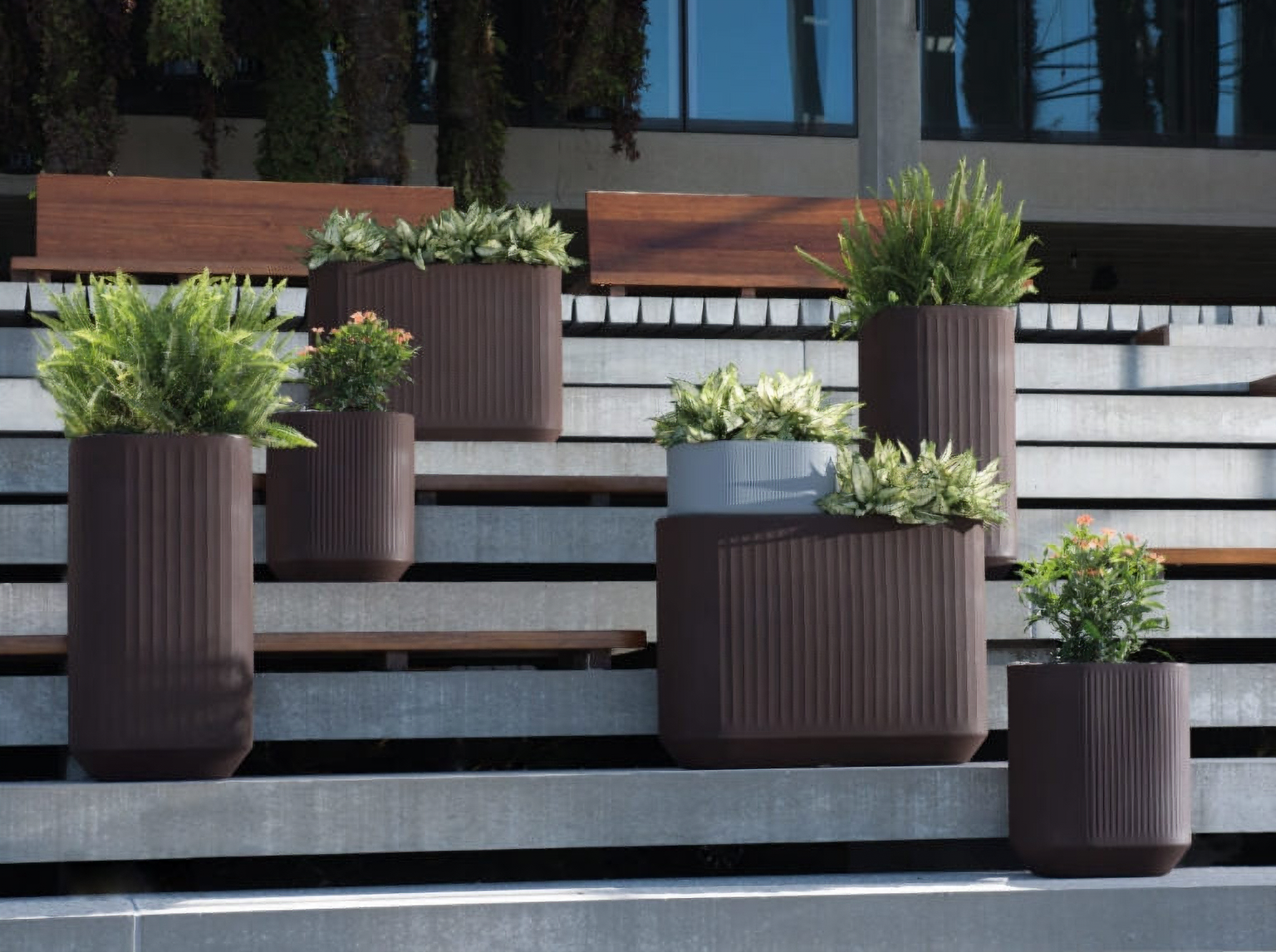
Layer planter sizes and heights. Three planters of the same size in a row reads as a barrier. Three planters at varying heights reads as a garden.

The Small Details
A few small details separate a good planter arrangement from a great one.
Match the planters to each other, but not to everything else. Two matched planters at the entrance to the patio. Three matched planters along the pool deck. The repetition creates rhythm. Mixing every planter reads as busy.
Layer plant sizes within each planter. A single mature plant in a large planter reads as sparse. A mature plant with two or three smaller plants trailing over the edges reads as full.
Use lighting to feature the planters at night. Uplight the tallest ones from below, and the plants read like sculpture in the evening. Layered that includes the greenery — not just the furniture — is the single biggest lift the average outdoor space is missing.
Bring the Resort Home
The best-designed outdoor spaces do not just have plants. They have plants placed with intention — in planters that read as architecture, in arrangements that give the space its rhythm, in a relationship with the that turns a patio into a garden room.
Frontera has spent over three decades curating the pieces that make this possible.
Explore our collections. Bring the resort home.
Explore More