
The Hammock, The Porch Swing and the Art of Doing Nothing
The art of doing nothing is harder than it sounds.
Our world has glamorized the art of overdoing, overachieving and overbooking ourselves. Rarely are we celebrated for doing nothing.
And yet, sometimes it's exactly what we need. Whether we carve out a moment in the early morning, midday or evening, we have to make it a priority — or everything else will take its place.
Some outdoor furniture is made specifically for this — a hammock between two trees, a porch swing beside the front door, a lounge chair angled toward the garden. Furniture designed for stillness.
At Frontera, we've spent over three decades crafting furniture designed to help you slow down and relish in all you've achieved.
The Hammock: Small Investment, Big Impact
There is no piece of outdoor furniture that changes a backyard's daily rhythm quite like a hammock. A dining table needs guests. A pool needs a swimsuit. A hammock needs only that you exist, briefly, without anything to prove.
Handwoven are made in Colombia to a standard the mass market hasn't quite matched. Cotton or weather-resistant synthetic, dyed in colors that suit a garden rather than a beach and woven tightly enough to cradle without pinching. The best ones look like textile art when they're empty and like a small piece of vacation when they're not.

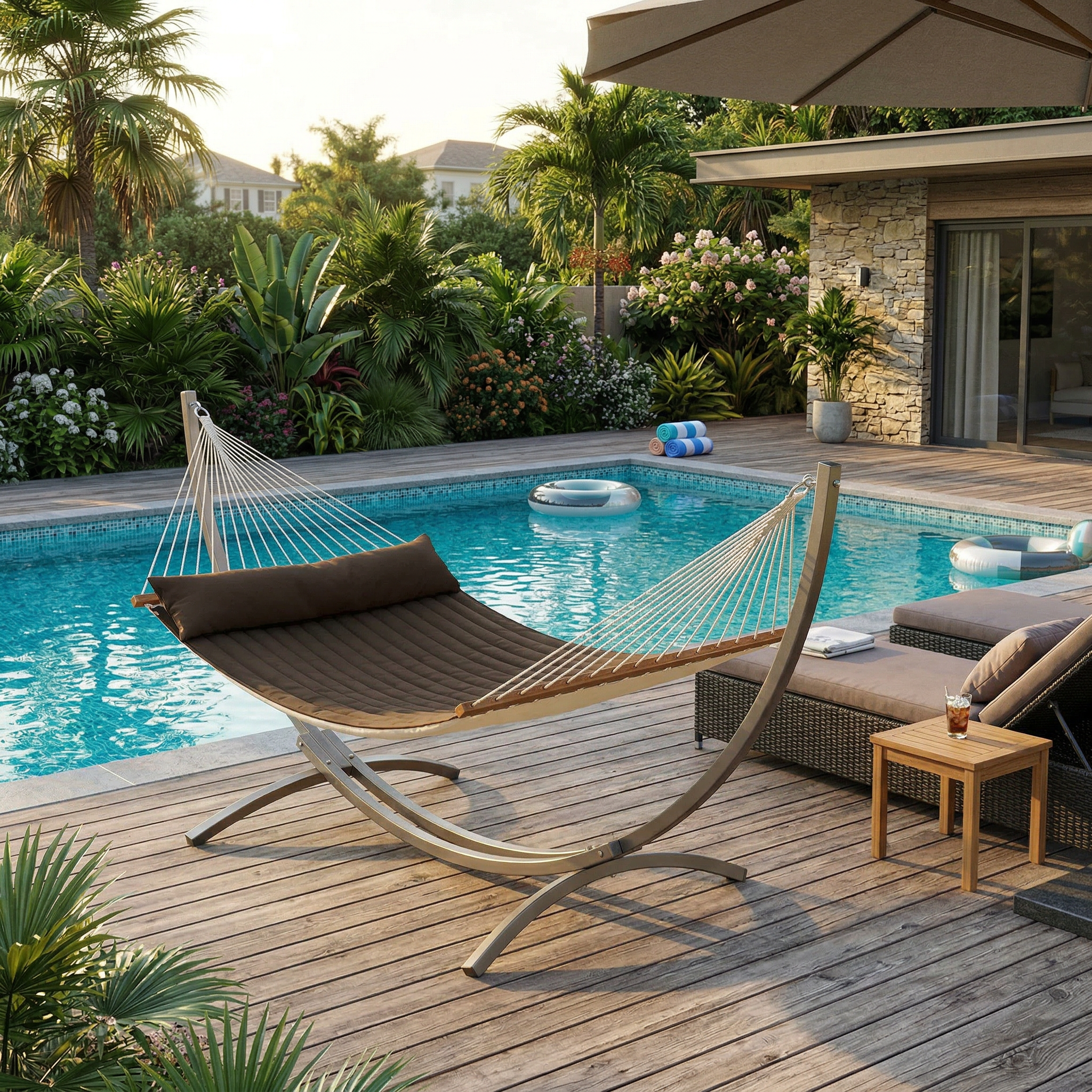
A few practical notes. The classic between-two-trees hammock needs trees roughly twelve to fifteen feet apart, so measure before you buy. For yards without the right trees, a freestanding hammock frame in teak or powder-coated steel accomplishes the same thing and can be placed anywhere. A hanging hammock chair, suspended from a beam or a heavy hook, is the compact version — perfect for a covered porch, a pergola corner or a screened patio.
Whatever version you choose, choose one you can imagine leaving out. A hammock that has to be put away after every use will get used a fraction as often as one that lives outside all summer.
The Porch Swing
If the hammock is the piece for solitary afternoons, the is the piece for the quiet company of one other person.
There is a reason porch swings have not gone out of style in a hundred years. They invite the specific kind of conversation that only happens when nobody is looking directly at each other — the good conversations, the ones you remember. They accommodate a book on one side and a cup of coffee on the other. They handle the seasonal shift with grace, moving from a summer morning perch to a fall evening one to a spring afternoon reading spot without complaint.
Teak porch swings are the resort standard. Weathered teak deepens to a quiet silver over years, and the material is dense enough that the swing does not creak — the sound of a cheap porch swing being the sound of a piece not built for real use. Pair the swing with cushions in a durable outdoor fabric and a few in warm textures, and you have created one of the most quietly used, most beloved pieces of outdoor furniture money can buy.
For homes without a covered porch, a porch swing on an A-frame stand — set under a tree, at the edge of a garden, or on a corner of the patio — brings the same effect. The swing is the piece; the porch is just where it happens to hang.

The Solo Lounge: A Room Within a Room
Most outdoor design defaults to seating in groups — two chairs together, a sectional for six, a dining table for eight. But some of the best outdoor spaces include a piece that is deliberately for one.
A single deep-seated club chair placed at the edge of a garden. A angled toward the morning sun. A hanging egg chair suspended from a pergola beam. These are the pieces that turn a backyard into a place you can retreat to — not from your guests, but from your week.
The rule for a solo piece is that it should be positioned for one, not for the group. Angle it toward something worth looking at — the water, the vegetable garden, a mature tree, the horizon. Pair it with a small sized for a cup and a book, nothing more. Add a soft throw within reach for the cooler part of the morning.
The right solo piece will become your favorite spot in the house.
The Details That Invite Stillness
A quiet outdoor perch is not the same as a beautiful one. The pieces that people actually use for slow mornings and quiet afternoons share a few small details.
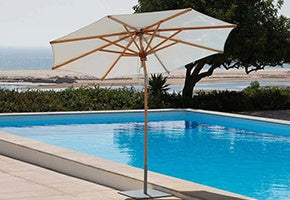
They are shaded, at least partially. Even the best hammock is unusable at high noon in July. A nearby, a pergola overhead, or simply a mature tree turns a piece from occasionally usable into daily usable.
They are private, or feel that way. A porch swing tucked around a corner. A hammock strung behind a hedge. A chaise angled away from the driveway. The best solo pieces feel like they belong to the person using them, even if the yard around them is open.
They are close to the things you need. A pitcher of water. A stack of books. A small table for a cup and a phone (turned face-down, ideally). The whole point of a slow-morning perch is that you are not making trips back to the house.

Slow Evenings, Too
A hammock and a porch swing are not just morning pieces. They are the transitional pieces of an outdoor room — the places you migrate to as the entertaining pieces empty out.
After a long dinner, guests will find their way to the swing. After a pool afternoon, the hammock is where someone reads while the water settles. As the light softens and the mosquito candles come on, the porch swing becomes the last remaining gathering point of the evening — one person, then two, then a small quiet trio watching the sky turn colors.
Layered around these spaces — a single lantern on the swing side, a soft path light near the hammock — extends their use into the evening without disturbing the calm they invite.
The Practice of Doing Nothing
Perhaps the most valuable thing a beautifully designed hammock or porch swing gives you is permission. Permission to sit down without a purpose. Permission to close the book on your chest. Permission to spend an hour looking at leaves.
Modern life is not particularly generous with unstructured time. A well-placed hammock or porch swing is a small architectural argument that unstructured time is worth having. That the good life is not the busy life. That some afternoons should be spent, not accomplished.

Bring the Resort Home
The most memorable rooms in the best resorts are often not the most photographed ones. They are the quiet corners — the hammock strung between two palms, the porch swing on the back veranda, the single chaise at the end of the dock. These are the pieces guests remember because they are the pieces that gave them back an hour of their day.
Frontera has spent over three decades curating the hammocks, porch swings, and that make this possible at home — from handwoven La Siesta hammocks to teak porch swings built to last a generation.
Explore our collections. Bring the resort home.
Explore More