Patio Umbrella Sizing Guide: Matching Coverage to Your Table, Patio and the Sun
Patio Umbrella Sizing Guide
An umbrella that's too small ruins a lunch. An umbrella that's too large dominates a patio. Getting it right comes down to three rules.
None of them are overly complicated but almost no one gets taught them.
At Frontera, we've spent over three decades helping discerning homeowners and designers choose that match the proportions of their outdoor lives. What follows is the sizing guide we wish every buyer had before making a purchase.
Rule 1: Measure Your Table, Then Add Two Feet
The most common patio umbrella mistake is buying for the table's diameter rather than for the people sitting around it. Hands and forearms drift outward. Plates, glasses, candles, and elbows extend the table's true footprint by an easy foot in every direction. An umbrella that exactly matches the diameter of your tabletop will leave the people using that table sitting in the sun.
The rule is simple and worth memorizing: your umbrella should be at least two feet larger than your table on every side. That means adding four feet to your table's diameter or longest dimension to find the minimum umbrella size.
A practical reference, by table:

For square tables, follow the same logic — measure the longest dimension and add two feet on each side. These figures are minimums. If your gatherings tend to linger, or if your sun is unforgiving, sizing up is almost always the right call.

Rule 2: Read the Sun, Not the Calendar
Your patio's sun is not the same as your neighbor's. A south-facing terrace in Charleston needs a different umbrella strategy than a west-facing dining patio in Sonoma or a north-facing balcony in the Pacific Northwest. The single most useful thing you can do before buying is to stand on your patio at noon, again at three, and again at five — and watch the shadows move.
Three patterns are worth knowing.
Midday sun falls nearly straight down. A traditional center-pole will cover the table directly beneath it. This is the most predictable sun pattern to plan for, and the most flattering.
Afternoon and evening sun travels at an angle, sometimes a steep one. A 10-foot umbrella that perfectly shades your dining table at noon may leave half the table in full sun by four o'clock. For patios that catch heavy afternoon light, consider a — the canopy adjusts on a hinge to follow the sun, extending usable shade through the long, golden hours when summer afternoons are at their best.
Variable light from multiple angles — the patios that catch sun from morning to dusk — calls for a different solution entirely. A places its pole to the side of the seating area, with the canopy suspended overhead and able to rotate, tilt, and angle independently of the table. For a deep patio or a poolside lounge area, no other umbrella style is as flexible.
Rule 3: Choose Your Shape and Your Placement
Once you know the sun and the table, the shape of your umbrella becomes a design decision as much as a functional one. The wrong shape over the right table just feels off.
A round canopy works beautifully over round and square tables, and it remains the most classic silhouette in outdoor design. Round market umbrellas — the kind you might recognize from the terraces of a Provençal café — offer balanced shade in every direction and pair best with round, octagonal, and hexagonal tables.
A rectangular canopy belongs over a rectangular table. A round umbrella suspended over an eight-foot dining table will leave the ends of the table exposed; a follows the table's geometry and shades the entire surface, end to end.
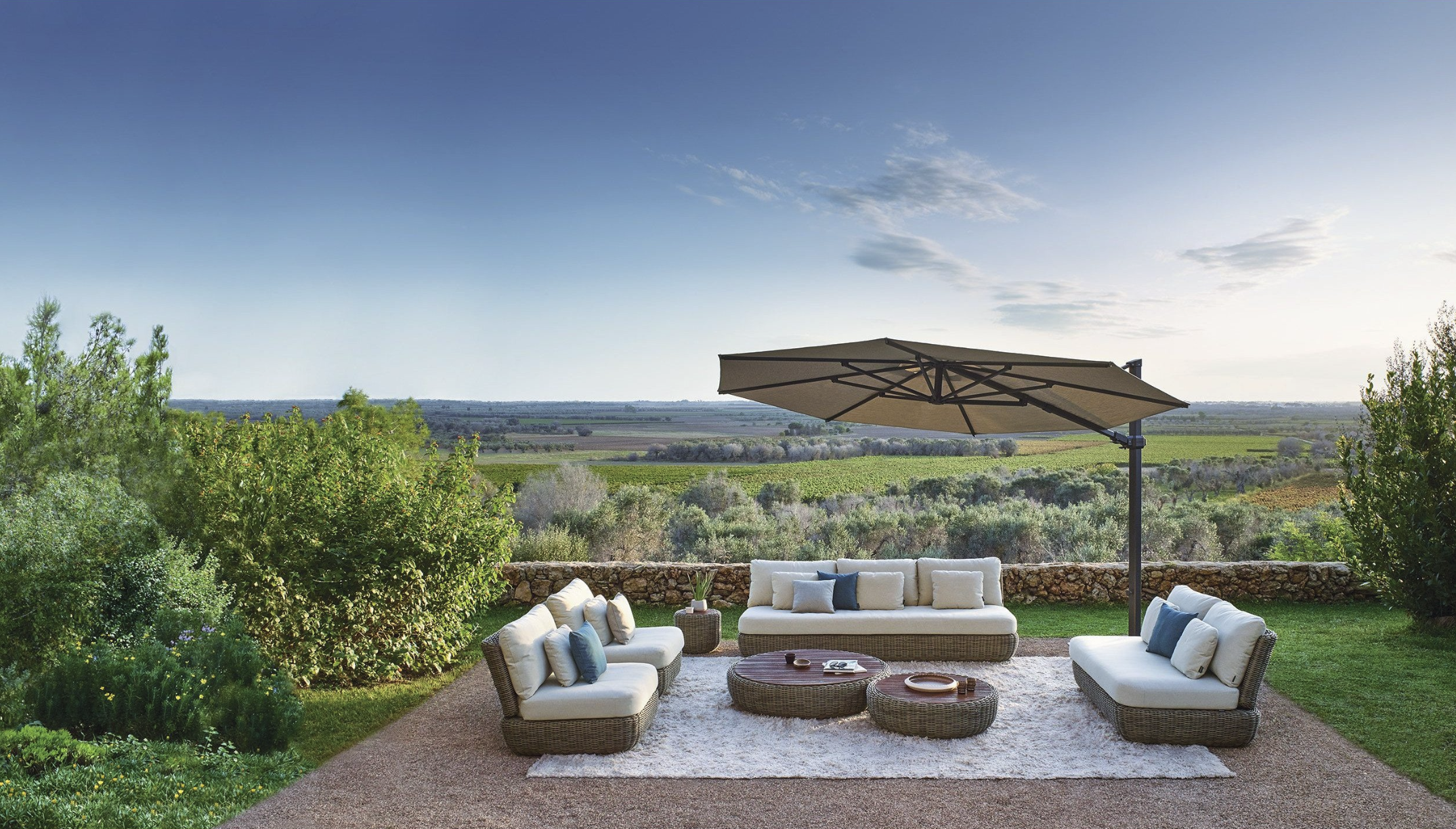
A cantilever shape — sometimes called a side-pole or offset umbrella — is the right choice anywhere a center pole would interrupt the space. It is the umbrella for by the pool, for sectional sofas where guests gather around a low coffee table, and for any seating area where you want the shade without the pole through the middle of the conversation.

Two final placement notes worth knowing.
A center-pole umbrella should sit through the umbrella hole of a table designed to receive it. If your table has no hole, you will need a to adapt the opening, or a freestanding base placed beside the table.
A cantilever umbrella requires clear ground beneath its base — typically a four-by-four-foot zone — and the base itself must be substantial enough to counterweight the offset canopy. Which brings us to the most overlooked variable in patio umbrella ownership.
The Base: The Detail That Determines Whether It Lasts
A beautiful umbrella on an undersized base is the patio equivalent of a chandelier hung from a thumbtack. The base is not an accessory. It is the umbrella's foundation, and it is the single most-overlooked variable in outdoor umbrella longevity and safety.
A useful guideline by canopy size:

These are minimums in calm conditions. Coastal homes, hilltop patios, and any space that catches gusts should size up. A few extra pounds at the base of an umbrella is the difference between a piece that lives gracefully through every season and one that becomes a story you would rather not have told.
from premium makers are engineered with the canopy in mind — weighted, balanced, and finished to disappear underfoot while the umbrella does its work, season after season.
Fabric, Frame, and the Quiet Details of Longevity
A resort-quality patio umbrella is more than its dimensions. It is a series of small, considered decisions about material — the kind of decisions that determine whether your umbrella looks like itself in year ten or year two.
Canopy fabric is where the difference between ordinary and exceptional becomes visible. Solution-dyed acrylic fabrics — Sunbrella being the most recognized name — resist fade, mildew, and the slow dulling that polyester catches within a single summer. The color you choose on day one is the color you live with for the life of the canopy. Premium fabric is the difference between an umbrella you replace and one you keep. , one of the most trusted names in the industry, anchors much of the canopy work you will find in the world's finest hotels.
Frame material matters more than you might expect. Powder-coated aluminum is light, rustproof, and ideal for most climates. Teak and other fine hardwoods bring warmth to the design and weather to a quiet silver patina over time. Specialty makers like build high-wind umbrellas with reinforced ribs and aerodynamic canopies for coastal homes and exposed properties where weather is part of the brief.
Lighting and finishing details — discrete LED tucked into the ribs, beautifully turned wooden poles, hand-stitched valances — are the touches that take a patio umbrella from functional to memorable. The kind of details that, when the sun goes down and the candles come out, make the umbrella feel less like a piece of equipment and more like a part of the room.

Sizing for Dining, Lounging, and Deep Seating
Different parts of an outdoor room call for different umbrella sizing logic.
Over a dining table, the table is the anchor and the rule is the one above: add two feet on every side. A center-pole market umbrella is the classic choice, and your dining set is the dimension to plan around. Allow extra room if your dining gatherings tend to fill the chairs and then some.
Over lounge chairs and club chairs, dimensions are different. Plan to shade not just the seat but the reader's head, the side table, and the drink. A 9- to 11-foot cantilever umbrella works beautifully over a pair of chaise lounges; an 11- to 13-foot canopy will cover a small lounge grouping with room to spare.
Over deep seating sets — sectionals, swivel club chairs, low coffee tables — the cantilever umbrella is almost always the right answer. There is no table to mount through, and the geometry of deep seating asks for shade that flows from above without a pole interrupting the conversation.
When One Umbrella Is Not Enough
The most elegant outdoor rooms often rely on more than one umbrella. A long rectangular table for ten may be better served by two nine-foot umbrellas than one thirteen-foot canopy — the look is symmetrical, the shade is more flexible, and each canopy is easier to manage. A poolside lounge area might combine a tilting umbrella at the conversation set with a cantilever umbrella over the chaise lounges, layering shade the way you might layer light in a thoughtfully designed room.
For the most ambitious outdoor spaces, pergolas and canopies take shade from an accessory to architecture — a permanent, sculptural answer to the same question umbrellas ask. They become the bones of the outdoor room rather than its punctuation.
The principle in all of these layouts is the same. Shade is a generous gesture. Plan for more of it than you think you need.
Care, Storage, and the Long View
Even the finest patio umbrella benefits from care. Lower the canopy in high wind, even briefly. Use a when the umbrella will be unused for weeks at a time, particularly between seasons. When summer ends and the canopy is ready to come down, store it folded and fully dry, and bring the base indoors if your winters are wet or freezing. A patio umbrella that has been carefully preserved will look like itself for a decade or more — exactly the way a Frontera piece is meant to.
The Right Umbrella, the Right Afternoon
A patio umbrella is, in the end, an invitation. It tells your guests where to gather, it slows the pace of the meal, and it frames the kind of long, unhurried afternoon that becomes a memory. Get the sizing right, and the umbrella disappears into the experience. Get it wrong, and it becomes the small, persistent thing that pulls everyone out of the moment.
If you are choosing a patio umbrella for the season ahead, the Frontera team is here to help. We have spent over thirty years curating the finest outdoor shade — from the timeless craftsmanship of teak umbrellas built to last generations, to engineered, wind-tested designs for the most exposed properties. Every piece is selected with the same care a resort designer brings to a five-star property.
Explore our collections. Bring the resort home™
Explore More